Improving the ADMET Profile of Prodrugs: From Rational Design to AI-Guided Optimization
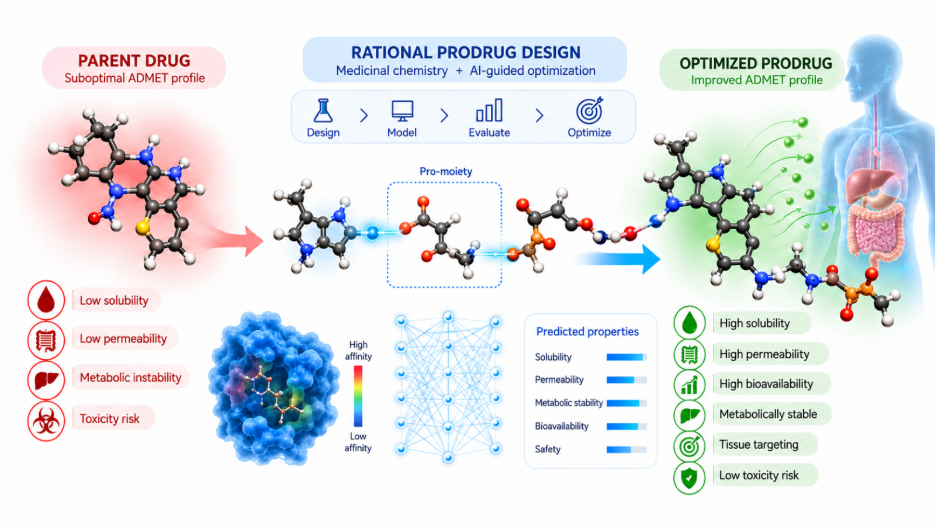
A promising drug molecule may show excellent biological activity but still face development challenges because of poor absorption, distribution, metabolism, excretion, and toxicity (ADMET) properties. Prodrug design provides an important strategy to overcome some of these limitations. A prodrug is a chemically modified derivative of an active drug that undergoes enzymatic or chemical conversion in the body, to release the active compound. Prodrug design can enhance key properties such as solubility, permeability, bioavailability, metabolic stability, tissue targeting, and tolerability.
Improving the ADMET profile of a prodrug is particularly important because its performance depends not only on the properties of the parent drug but also on its conversion rate, metabolic pathway, distribution, and safety of the released promoiety. An effective prodrug must remain sufficiently stable during formulation and administration while converting efficiently to the active drug at the appropriate biological site.
Standard Strategies for Improving Prodrug ADMET Properties
Traditional prodrug development begins by identifying the major limitation of the parent molecule. Poor aqueous solubility may be addressed by introducing ionizable or hydrophilic pro-moieties, whereas low membrane permeability may be improved by temporarily masking highly polar functional groups. Ester, amide, phosphate, carbonate, and carbamate derivatives are commonly explored depending on the required stability and activation mechanism.
Candidate prodrugs are subsequently evaluated through physicochemical and biological assays covering solubility, permeability, plasma stability, microsomal stability, protein binding, metabolic conversion, enzyme interactions, pharmacokinetics, and toxicity. It is also important to characterize the enzymes responsible for prodrug activation and assess the potential formation of undesirable metabolites or drug–drug interactions. The objective is therefore not simply to improve one property, but to achieve an appropriate balance across multiple ADMET parameters.
AI and Computational Approaches to Prodrug Optimization
Computational chemistry and artificial intelligence (AI) are increasingly supporting prodrug design before extensive synthesis and experimental testing. Molecular descriptors, quantitative structure–activity relationship models, molecular docking, molecular dynamics, and metabolism prediction can help researchers evaluate how structural modifications may influence absorption, stability, enzymatic conversion, and toxicity.
Machine-learning and deep-learning models can rapidly predict ADMET endpoints such as aqueous solubility, intestinal permeability, CYP interactions, plasma protein binding, clearance, metabolic stability, and toxicity across large virtual libraries. This enables researchers to generate several possible pro-moiety and parent drug combinations computationally and prioritize candidates with more favorable predicted profiles for experimental validation.
Recent Advances and Industrial Applications
Recent advances are moving prodrug optimization toward multi-parameter and AI-guided design. Graph neural networks, molecular representations, and integrated ADMET models can evaluate several pharmacokinetic and safety properties simultaneously rather than optimizing individual endpoints independently. Computational approaches can also be combined with physiologically based pharmacokinetic (PBPK) modelling to investigate how changes in absorption, metabolism, and prodrug-to-active-drug conversion may influence systemic exposure.
In the pharmaceutical industry, these approaches can support lead optimization, candidate selection, formulation development, preclinical planning, and clinical-development decisions. Early computational assessment helps teams prioritize promising prodrug candidates, identify potential metabolic or toxicity liabilities, and reduce unnecessary synthesis and testing.
Overall, integrating prodrug chemistry, computational modelling, ADMET prediction, PBPK approaches, and AI/ML provides a more systematic strategy for designing prodrugs with improved pharmaceutical properties and supporting more efficient, data-driven drug development.
To know more about our exploration of in silico ADMET profiling, prodrug optimization, and computational drug-discovery solutions, please contact Prescience at support@prescience.in or visit https://prescience.in/ and https://prescience.in/prins3/.