
Dynamics and Disorder in Catalytic Site-Ensembles
This event was successfully completed
Event Date:
March 26 - March 26, 2025
Application Area: Drug Discovery, Material Design
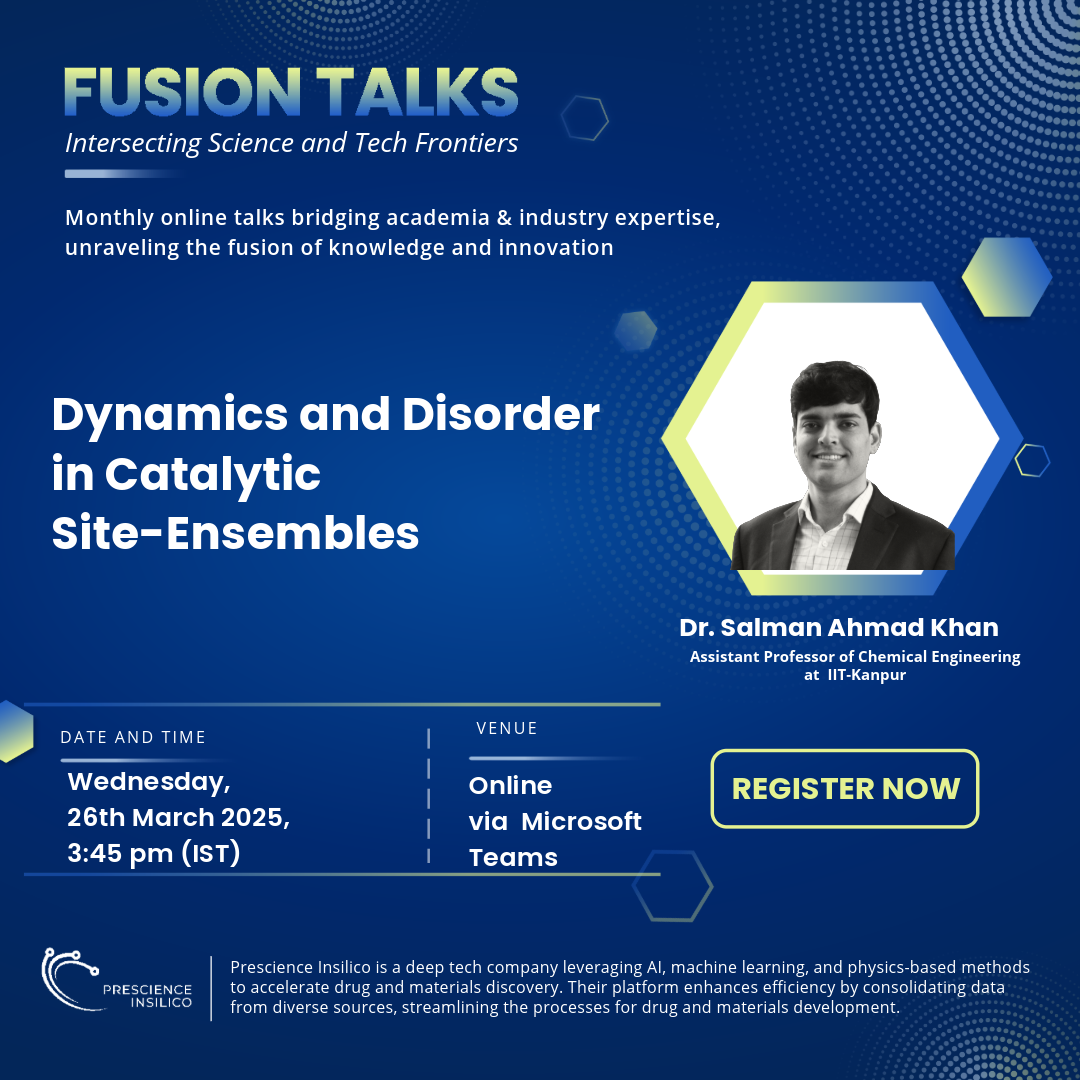
About the Speaker:-Salman Ahmad Khan is an Assistant Professor of Chemical Engineering at the Indian Institute of Technology Kanpur. He received bachelor’s and master's degrees in chemical engineering at the Indian Institute of Technology Kanpur. He studied catalysis, reaction rate theory, and rare events for a PhD with Baron Peters and Susannah Scott at the University of California Santa Barbara. In his PhD he developed methods to model amorphous catalysts and worked on understanding mechanisms of failure in rare events simulations. He did postdoctoral research with Dionisios Vlachos at the University of Delaware where he developed computational methods to model supported sub-nanometer cluster catalysts and machine learning tools to predict properties of hydrocarbon molecules.
Abstract:-First principles computational methods have greatly advanced our understanding of homogeneous catalysts and crystalline heterogeneous catalysts. In contrast, catalysts represented by site-ensembles, such as sub-nanometer clusters and amorphous catalysts, remain poorly understood. For these catalysts, active sites inherit different properties from their local environments. The observed kinetics are site-averages, typically dominated by a small fraction of highly active sites. In some materials catalyst sites are extremely sensitive to synthesis procedures and operating temperature. This complexity has hindered our understanding of these materials and as a result we do not have general design principles and tools for discovering new catalysts.
In this talk, he will present three method development efforts to model complex catalysts with site-distributions. First, he will present machine learning (ML), global optimization, and rare-events methods to model Al2O3 supported Pt clusters. Next, he will introduce an ab initio parameterized population balance modeling framework to simulate grafting of metal complexes onto amorphous supports (route to synthesize atomically dispersed amorphous catalysts). The framework will be applied to examine TiCl4 grafting onto amorphous silica. He will conclude by presenting an ‘importance learning’ algorithm which combines ML and importance sampling to learn from rare data. Importance learning will be applied to efficiently calculate site-averaged properties of non-Boltzmann distributions in amorphous catalysts.