
From Science of Intelligence to Machine Intelligence
This event was successfully completed
Event Date:
April 25 - April 25, 2025
Application Area: Drug Discovery, Material Design
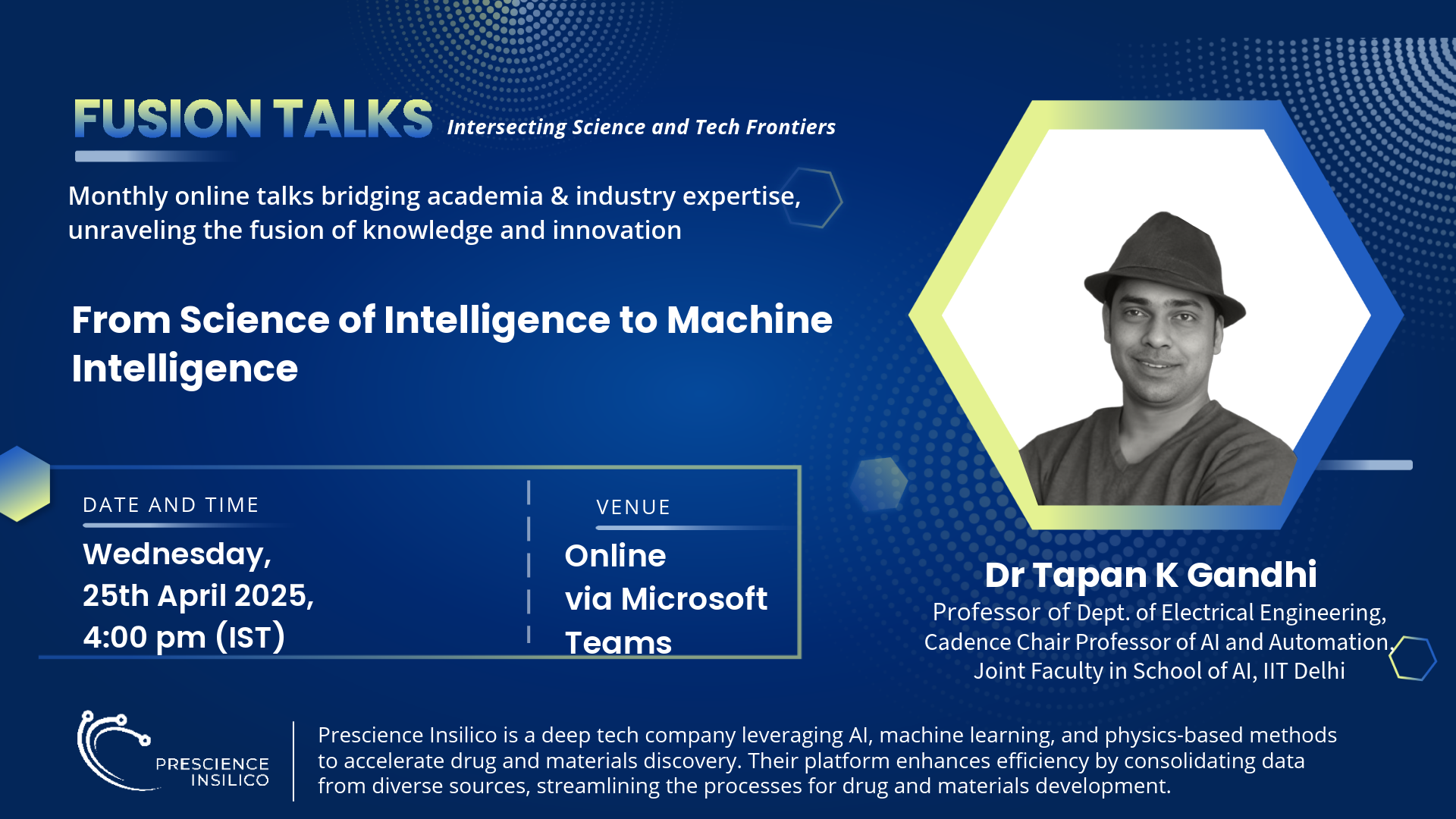
About the Speaker:-Dr Tapan K Gandhi is working as Professor in the Dept. of Electrical Engineering, Cadence Chair Professor of AI and Automation, Joint Faculty in School of AI, IIT Delhi. Dr Gandhi’s research expertise spans from Brain Mapping, Artificial Intelligence to responsible gaming. Dr Gandhi is leading couple of National and International projects at the interface of AI and Healthcare. His research work is not only published in top-notch journals like Nature, Science, PNAS but also appeared in many popular presses including TIME magazine, the Boston Globe, the New York Times, MIT News, Harvard News, Wall street Journal and also in the SCIENCE Magazine. He is serving as expert member (Task Force) in various research and strategic committees in Govt. of India including expert member under the National One Health Mission to formulate Technology enhanced integrated surveillance and outbreak investigation. He is elected Fellow of National Academy of Engineering (FNAE), Elected Fellow of National Academy of Sciences, India (FNASc.) and elected Fellow of International Artificial Intelligence Industry Alliance (AIIA).
Abstract:-The pursuit of machine intelligence is deeply rooted in understanding the principles of natural intelligence. Visual learning has provided critical insights and advancements in recent past. The hierarchical processing of visual information in the brain, from simple edge detection to complex object recognition, has been mirrored in convolutional neural networks (CNNs). This has not only improved performance in computer vision but has also influenced other areas of AI, including natural language processing and reinforcement learning. For instance, attention mechanisms, initially developed for image captioning, are now fundamental to transformer networks, which have significantly advanced language understanding. Techniques like transfer learning, where knowledge gained from visual tasks is applied to other domains, and meta-learning, where models learn to learn better, are enabling AI to generalize more effectively. The advancements in generative models, such as variational autoencoders (VAEs) and generative adversarial networks (GANs), have also been fuelled by visual learning, allowing machines to create and manipulate visual content, and providing new avenues for unsupervised learning.
In this talk, the speaker presents work conducted at the intersection of visual development, learning, and artificial intelligence. They highlight that understanding the fundamental mechanisms of visual learning is essential not only for addressing core scientific questions but also for driving progress in autonomous AI systems.